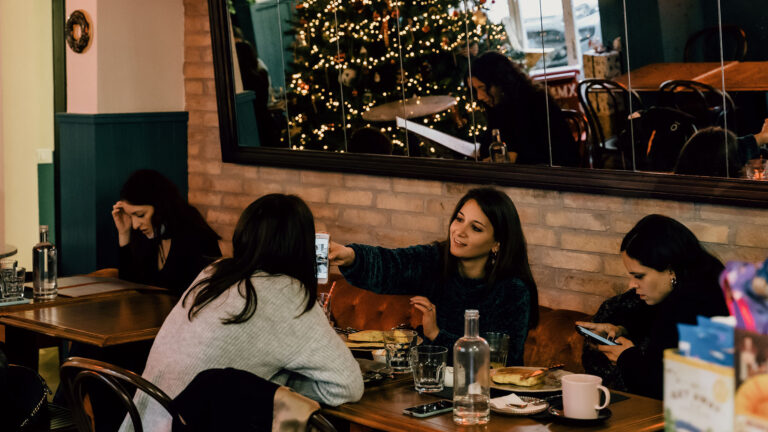
As English speakers we can afford to be lazy – by a quirk of fate our language is the language of international tourism and most everyone you meet in Rome will speak at least a few words of English. But being able to use even a few words in the country your visiting will go miles to unlocking smiles and spreading a feeling of mutual respect.
Here are a few very common words or phrases you can learn before you come. Because Italian is a romance language nothing about the grammar is entirely straightforward, so this is by no means comprehensive – but with these very basic fundamentals you will be able to show people you encounter that you’re not just yet another faceless tourist.
Before committing these to memory, please read our pronunciation guide, which will ensure that you fix the correct way of saying all the letters before you learn the words!
Table of Contents
Greetings
Hello
Buongiorno (bwon JORR-no) – good morning/hello (until noon)
Buonasera (bwona SEHR-ah) – good afternoon/evening
Ciao – Hi (informal)
Salve (sahl-VEH) – Hi (to a stranger)
Goodbye
Arrivederci (arr-EE veh-DERR-chee) [the rr is trilled] – goodbye (to a stranger)
Ciao – bye!
Buona giornata (bwon-a jor-NAH-tah) – have a good day (to a stranger/friend)
Buona serata (bwon-a ser-AH-tah) – have a good evening (to a stranger/friend)
Buon lavoro (bwon lah-VORE-oh) – have a good day at work (in the morning to someone obviously going to start their day)
Politenesses
Please
Per favore (per fah-VOR-eh) – do not confuse pronunciation with the Spanish porfavor, as many do!
Thank you
Grazie (GRA-tsyeh) – thank you
Grazie tante (GRA-tsyeh THAN-the) – thank you very much
La ringrazio (lah reen-GRAHTS-ee-oh) – thank you very much indeed (formal)
You’re welcome
Prego (PREH-go) – this is also used to say “go ahead”, such as when showing people to their seat or letting someone sit down.
Numbers
Uno (OON-oh) – one
Due (DOO-eh) – two
Tre (treh) – three
Quattro (KWAT-roh) – four
Cinque (CHEENK-way) – five
Sei (SAY) – six
Sette (SET-teh) – seven
Otto (OT-toe) – eight
Nove (NOH-veh) – nine
Dieci (dee-EH-chee) – ten
Undici (OON-deeshee)
Dodici (DOE-deeshee)
Tredici (TRE-deesee)
Quattordici (kwat-OR-deeshee)
Sedici (SAY-deeshee)
Diciassette (DEESH-ah-SET-te)
Diciotto (DEESH-otto)
Diciannove (DEESH-a-noh-veh)
Venti (as they say it in Starbucks!) – twenty
Ventuno – twenty one
Etc.
Trenta (TREN-tah) – 30
Quaranta (kwa-RAN-tah) – 40
Cinquanta (cheen-KWAN-tah) – 50
Sessanta (sei-SAN-tah) – 60
Settanta (set-TAN-tah) – 70
Ottanta (ot-TAH-tah) – 80
Novanta (no-VAN-tah) – 90
Cento (CHEN-toh) – 100
Duecento (doo-eh-CHEN-toh) – 200
Etc.
Seicentocinquantatre (say-CHEN-toh-cheen-KWAN-tah-tre) – 653
Mille (MEEL-eh) – thousand
In a restaurant
Siamo in [numero] (see-AH-moh een [number]) – There are [number] of us.
Dentro o fuori? (DEN-tro oh FWOR-ee) – Indoors or outdoors?
Liscia o frizzante? (LEE-sha oh free-TSAHN-teh) – Still or sparkling (water)? Regular water is also referred to as naturale (na-too-RAH-leh).
Dov’è il bagno? (Dove eh eel BAN-yo?) – where’s the bathroom
Al fondo in destra/sinistra (al FON-doh een DES-tra/seen-EES-tra) – at the end on the left/right
Il conto (eel CON-toh) – the bill/check
Carta o contanti? (CART-ah oh con-TAN-tee) – card or cash?
See here for more restaurant vocabulary…
Shopping
Quanto costa? (KWAN-toh COST-ah) – how much is it?
Una busta la vuole? (oona BOOS-tah lah VWOL-eh?) – Would you like a bag?
Costa troppo (COST-ah TROP-poh) – too expensive
Sconto (SCON-toh) – discount
Pronunciation guide
The good news is that written Italian is almost completely phonetic.
There are a few simple rules about Italian pronunciation that you can learn, and then you will be able to pronounce Italian words almost perfectly.
Vowels
All vowels are always pronounced the same:
A = ah
E = eh
I = ee
O = oh
U = oo
Vowels are pronounced in full in combination. AO = ah-oh, EU = eh-oo. UO = oo-oh, etc.
Consonant pronunciation
Most consonants are pronounced almost exactly as they are in English. Note the following minor differences:
R: The Italian R is rolled, similar to Spanish. A single R is a single trill (like a short ‘d’), while a double RR is a longer trill.
T: The letter T is slightly softer, slightly towards our ‘th’, but never becomes the very soft ‘d’ sound at the end of a word that is common in many dialects of American English (e.g. pronouncing “Totti” as “Toddi” is not something that would happen in Italian).
Z: The letter Z is pronounced “ts”.
Consonant combinations
CI and CI
CI is pronounced “chee”
GI is pronounced “jee”
But when another vowel follows CI or CE, they are pronounced “CH” and “J” only. E.g. the name Giovanni is “joe-VANN-ee” and Gio is “Joe”, ciabatta is pronounced “cha-BATT-ah” – in other words you don’t say the “I” sound.
CE and GE
CE is pronounced “che”
GE is pronounced “je”
CH and GH
The “H” is introduced to harden up CI, GI, CE, and GE. It is the complete opposite of English “CH”.
CH makes a hard K sound.
GH is a hard G sound.
E.g. Ghetto (GET-toe), Chiara (kee-AH-ra), etc.
GL
GL is pronounced “ly”.
In the famous Emma D’Arcy “negroni sbagliato” clip, she pronounces the “gli” incorrectly – sbagliato should in fact be pronounced “zbal-YA-toe”.
GN
GN is pronounced “ny”.
Gnocchi is “NYOCK-ee”.